




 +82 51.977.8000





How Do You Do a Deviated Nasal Septum Self-Check at Home?
A deviated nasal septum self-check at home follows three steps in order: breathing with one nostril blocked, looking for asymmetry in a mirror, and recording the pattern over several days.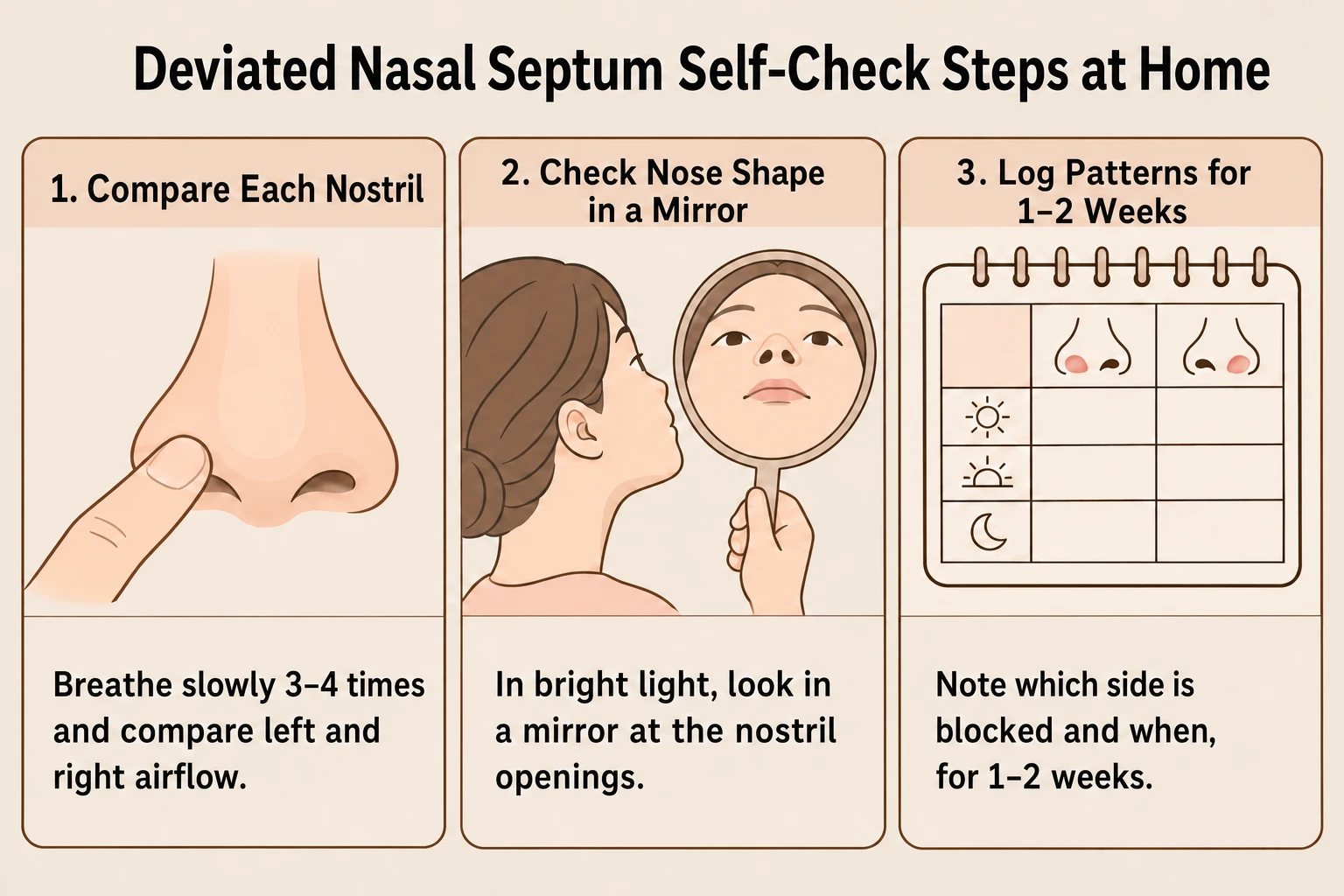
To make the self-check more accurate, it is best to avoid doing it right after exposure to cold air or in a dry environment, and to start at normal indoor temperature after gently blowing your nose to clear any discharge.
This is because on days when cold or acute allergic rhinitis symptoms are severe, the entire nasal lining is swollen, so it is difficult to tell from a self-check alone whether the narrowing is structural, caused by bone and cartilage, or simply swelling from inflammation.
In addition, even a normal nasal lining goes through the 'nasal cycle', in which the left and right sides take turns swelling and shrinking every 2–7 hours under the control of the autonomic nervous system, so a passing sensation alone makes it hard to tell this apart from a deviated nasal septum.
So rather than deciding you have a deviated nasal septum based on a passing sensation, it is important to keep brief notes for at least 1–2 weeks on which side is blocked, the time of day (right after waking or during sleep), and whether it improves after taking rhinitis medication.
These accumulated self-check records can serve as reference material at a later ENT consultation for distinguishing structural abnormalities and symptoms.
Breathing With One Nostril Blocked at a Time
To check for a deviated nasal septum by breathing through one nostril at a time, keep your mouth closed, press one side of your nose lightly with a finger, breathe in and out slowly 3–4 times through the open nostril, and compare the air resistance with the other side.
- Comparing airflow: If, even when you repeat the check at different times of day over several days, noticeably less air always comes in through the same nostril and you cannot take a full breath, a deviated nasal septum may be suspected.
- Checking whether the nostril collapses on inhalation: If, when you breathe in hard, the nasal wing (ala) on the narrower side is pulled inward and the airway closes completely, it is likely that nasal valve stenosis is present as well as a deviated nasal septum.
During the self-check, do not press the side of your nose so hard that you also squash the opposite passage, and avoid putting a cotton swab or finger deep into the nose, as this can cause injury to the nasal lining and secondary infection, so please take care.
Looking at the Shape of Your Nose in a Mirror
To self-check by looking at the shape of your nose in a mirror, tilt your head back slightly, about 45 degrees, under bright lighting, look up into the mirror and check the nostrils for any asymmetry in shape and the central axis of the septal column.
- Look for a leaning columella: If the inner wall of the central column that divides the nostrils (the columella) leans to one side and narrows the nostril opening into a half-moon shape, the caudal septal cartilage at the very front of the septum is likely to be bent.
- Check for external nasal asymmetry: If, viewed from the front, the bridge of the nose is bent into a C or S shape (a crooked nose deformity), the likelihood of a deviated nasal septum is high.
What you can self-check from what you see in the mirror is limited to the nasal vestibule (the nostril opening).
A bony septal deviation located deep inside the nose is not easily visible from the outside, so it is best to use self-check results for reference only.
What Is on a Deviated Nasal Septum Self-Check Checklist?
A deviated nasal septum self-check checklist looks at whether nasal congestion is fixed and persistent, how it responds to rhinitis medication, and whether there are sleep problems or bleeding from the nasal lining.
To tell a deviated nasal septum apart from a simple cold or temporary rhinitis triggered by your surroundings, check whether the symptoms on the self-check checklist appear consistently for several weeks or longer.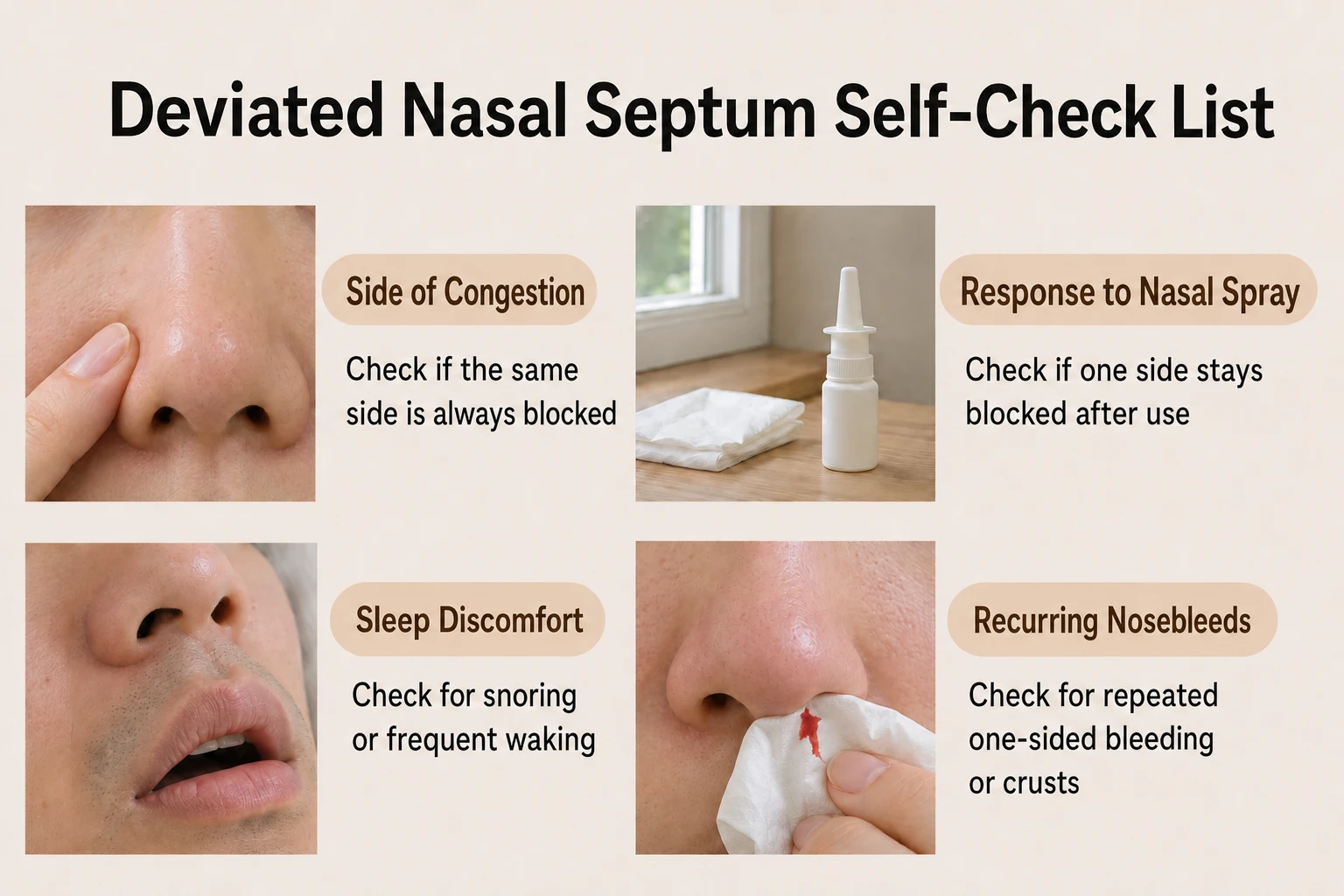
| What to check | Self-check criterion | Clinical meaning and cause |
|---|---|---|
| Side of nasal congestion | The same side of the nose is always blocked | The airway is physically blocked by protruding septal cartilage·bone |
| Response to medication | One side stays blocked even with rhinitis medication | Swelling of the nasal lining may ease, but the bent bony structure does not change |
| Sleep problems | Snoring, frequent waking and a dry mouth in the morning | A lack of oxygen caused by increased airway resistance when lying down |
| Sleeping position | Breathing is easier only when lying on a particular side | Position-related breathing imbalance due to a difference in width between the left and right nasal passages |
| Repeated bleeding | Nosebleeds and crusting happen often, and only on one side | Airflow is pushed to one side, so the nasal lining dries out and becomes sore easily |
If three or more items on the self-check checklist apply to you and they have been interfering with daily life for several weeks or longer, rather than relying on medication alone, we recommend an ENT examination to check the structure of your nasal cavity and whether you have a deviated nasal septum.
What Are the Limits of a Deviated Nasal Septum Self-Check?
The limit of a deviated nasal septum self-check is that conditions that cause nasal congestion, such as inferior turbinate hypertrophy, allergic rhinitis and nasal valve stenosis, are often intertwined, so patients cannot confirm the main cause on their own.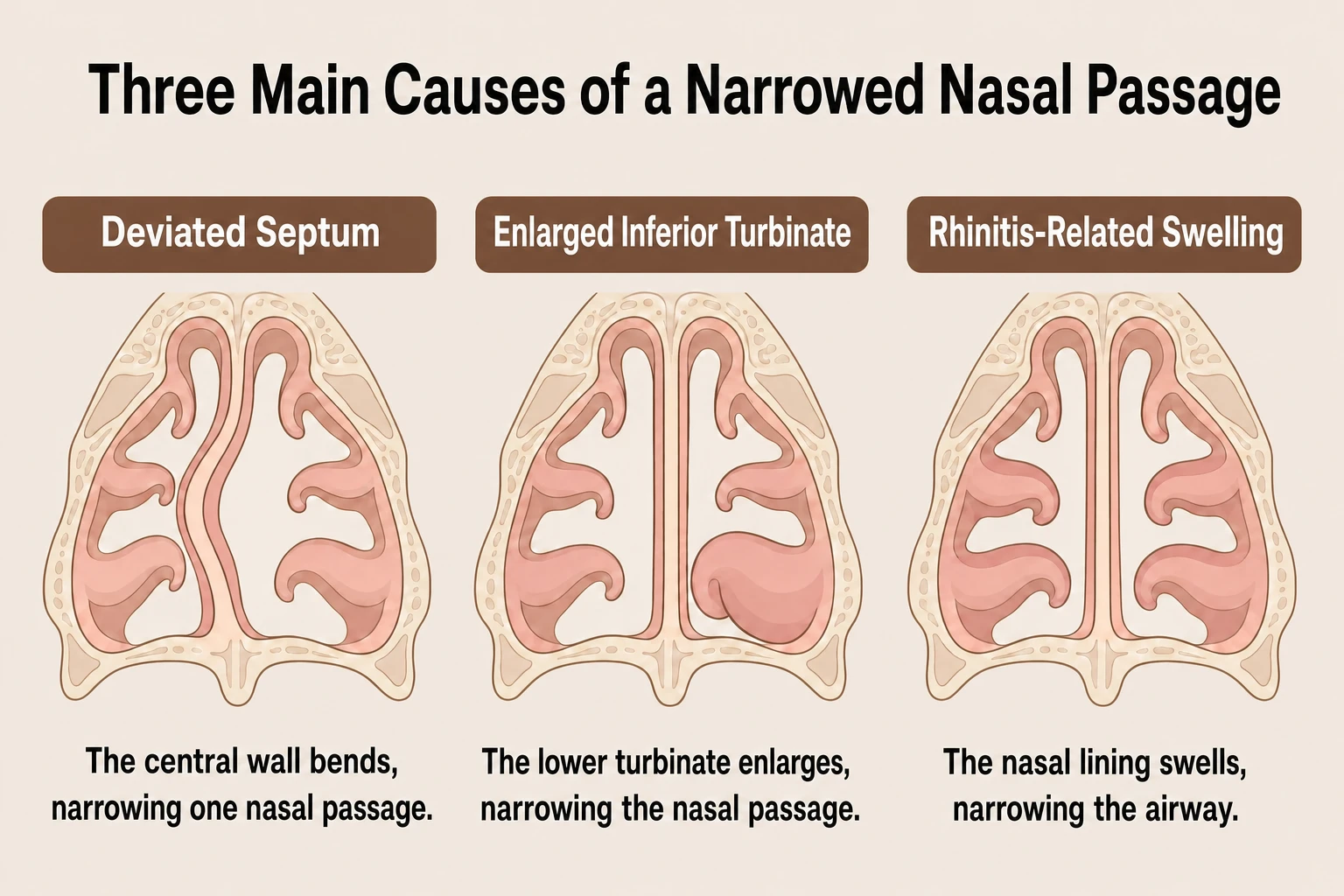
When self-checking, many people think of 'only one side being blocked' as the hallmark of a deviated nasal septum, but in practice, 'compensatory hypertrophy', in which the mucosal tissue thickens to fill the space on the side opposite the deviation, is often present as well.
In this case, not only the deviated side but also the wider side becomes blocked, with both sides alternately feeling completely blocked, so patients can easily mistake it for simple rhinitis and miss the structural problem.
| Condition | Pattern of congestion | Accompanying symptoms |
|---|---|---|
| Deviated nasal septum | One side is always blocked, and the side stays the same | A sense of physical blockage on the narrowed side remains even after medication |
| Allergic rhinitis | Both sides are blocked alternately and change with the environment | Bouts of sneezing, clear runny nose, and itchy eyes·nose |
| Inferior turbinate hypertrophy | Chronic congestion on both sides, mainly worse at night | Caused by proliferation of mucosal blood vessels and often occurs together with chronic rhinitis |
| Nasal valve stenosis | The upper wall of the nostril collapses when breathing in | A narrow roof structure in the upper nasal cavity greatly increases resistance when inhaling |
| Sinusitis | A persistent, heavy blockage on one or both sides | Purulent yellow nasal discharge, facial pressure pain, postnasal drip and reduced sense of smell |
Which Signs Mean a Deviated Nasal Septum Needs Urgent Consultation?
If the nose has just been injured, or there is foul-smelling pus discharge or repeated bleeding that will not stop from one side only, stop self-checking and seek an emergency consultation with an ENT specialist without delay.
This is because these symptoms, rather than pointing to a simple deviated nasal septum, are likely to be warning signs of a mucosal tear, haematoma, acute bacterial infection or a tumour inside the nasal cavity.
- Sudden blockage of both sides right after nasal trauma: If the nose swells rapidly and becomes completely blocked within a few hours of an injury, a 'septal haematoma', in which blood collects beneath the septal mucosa, should be suspected. If a haematoma is left untreated, the blood supply to the cartilage can be cut off, which may lead to saddle nose deformity as the cartilage breaks down, or to septal perforation, so immediate drainage is needed.
- Foul-smelling discharge from one side: If foul-smelling yellow pus or blood-tinged discharge continues from only one nostril, conditions such as a foreign body inserted by a child, fungal sinusitis, or nasal tumours such as inverted papilloma need to be ruled out.
- Recurrent bleeding from one side: If blood repeatedly pours from one side and does not stop even after 15~20 minutes or more of applying pressure, an endoscope should be used to check for dilated blood vessels in Kiesselbach's area or bleeding from the back of the nasal cavity, and electrocautery should be considered.
- Pauses in breathing during sleep (apnea): If obstructive sleep apnea is observed, where breathing stops for several seconds during heavy snoring and then resumes with gasping, early treatment should begin to help prevent cardiovascular complications such as stroke and high blood pressure.
Which Tests Are Needed After a Deviated Nasal Septum Self-Check?
If a deviated nasal septum self-check has picked up suspected symptoms, the next step is to assess the three-dimensional bony structure inside the nasal cavity and the condition of the nasal lining. This requires high-resolution nasal endoscopy, a nasal mucosal decongestion test, low-dose ENT 3D-CT and rhinomanometry.
At Masterpiece ENT Clinic in Busan, Representative Director Lee Tae-hoon uses high-resolution nasal endoscopy and 3D-CT to analyse the angle of bony septal deviation and any nasal valve narrowing that cannot be seen from the outside, in precise 0.1mm increments, to tell simple mucosal swelling apart from skeletal narrowing.
| Test | Method | Clinical diagnostic purpose |
|---|---|---|
| High-resolution nasal endoscopy | The inside of the nasal cavity is examined with 0°·30° electronic endoscopes | Real-time observation of mucosal redness, turbinate enlargement, polyps (nasal polyps) and mucopurulent discharge |
| Nasal mucosal decongestion test | Re-examination after inserting gauze soaked in a vasoconstrictor | Identifying purely structural narrowing of cartilage·bone that remains once temporary swelling has been reduced |
| Low-dose ENT 3D-CT | Precise cross-sectional imaging in 0.1mm increments | Three-dimensional analysis of the bony deviation angle of the posterior septum, the nasal valve angle and sinus ventilation |
| Rhinomanometry | Measurement of nasal pressure and airflow during inhalation·exhalation | Objectively verifying the stuffiness the patient feels by converting it into a measured physical resistance value |
At Masterpiece ENT Clinic, Dr. Lee Tae-hoon does not carry out detailed deviated nasal septum tests on every patient as a matter of routine.
The principle is to first confirm findings suggestive of a deviated nasal septum through a medical interview and basic endoscopy, and then, at the stage where surgical treatment is being considered, to measure the skeletal structure accurately with 3D-CT.
If a Deviated Nasal Septum Self-Check Suggests a Problem, Is Surgery Needed?
Even if a deviated nasal septum self-check suggests a problem, surgery is not always necessary. The decision is made step by step, based on how much discomfort you feel in daily life, the degree of nasal passage obstruction on detailed tests, and how you respond to medication.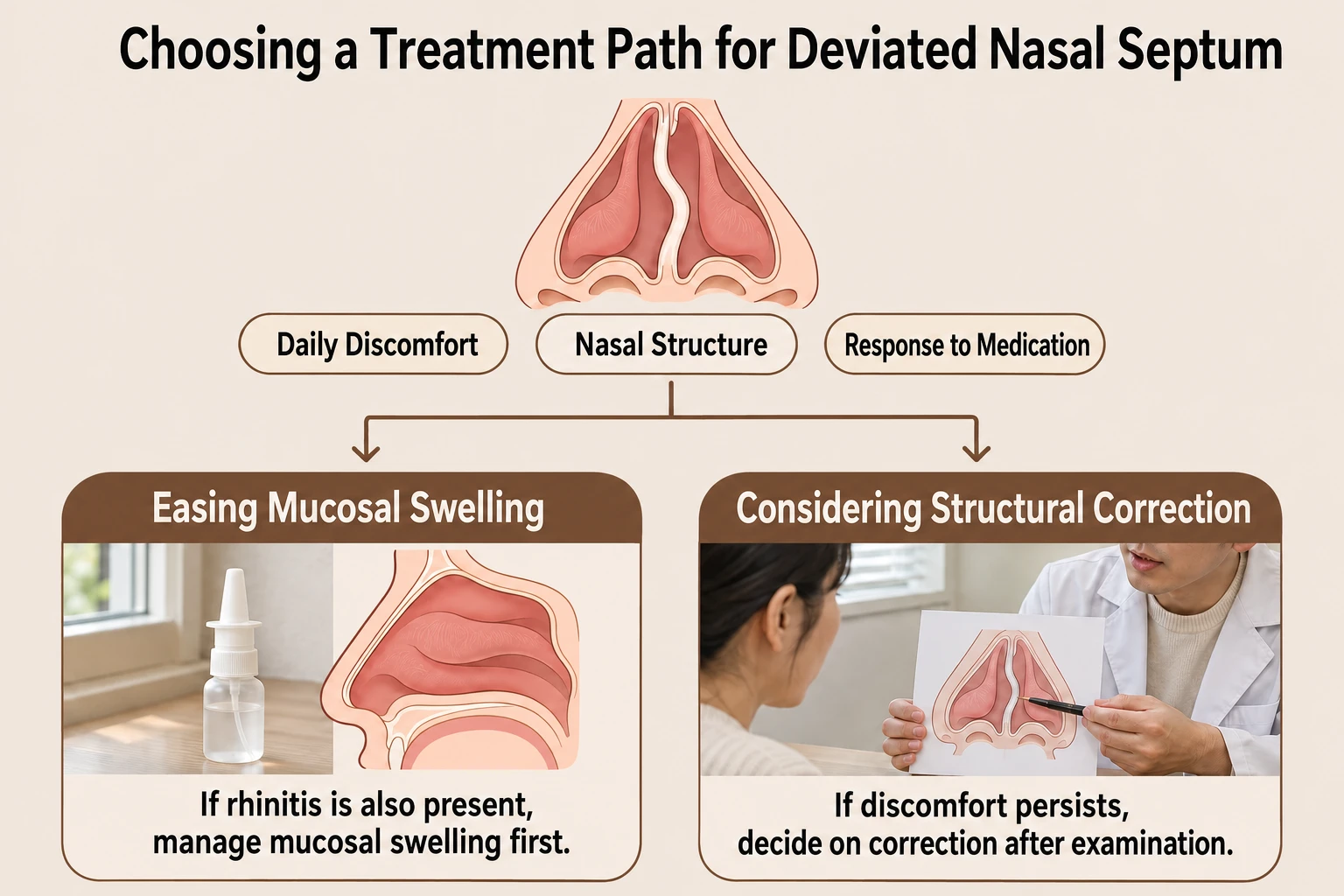
The nasal septum is a structure of bone and cartilage, so medication alone cannot straighten the deviation itself. However, for many patients, relieving the mucosal swelling caused by rhinitis is enough to open the airway sufficiently, so deviated nasal septum surgery is not needed.
| Treatment stage | Suitable for | Treatment at Masterpiece ENT Clinic |
|---|---|---|
| Stage 1: Conservative treatment | Mild deviation, patients with accompanying rhinitis | Oral antihistamines and nasal decongestants·Nasal steroid spray (topical spray)·Nasal irrigation with sterile saline 1~2 times a day |
| Stage 2: Septoplasty | No response to medication for 3 months or longer, complete structural obstruction | Selective correction of the deviated cartilage and bone through a submucosal incision·Repositioning into a straight shape while preserving the supporting structure |
| Stage 3: Combined functional correction | Nasal valve stenosis, accompanying chronic hypertrophic rhinitis | Septoplasty + radiofrequency inferior turbinate reduction (rhinitis)·Septoplasty + nasal valve reconstruction (widening the airway with a cartilage graft) |
Lee Tae-hoon, Representative Director of Masterpiece ENT Clinic, does not rush into surgery simply because an anatomical deviation is seen. He carefully distinguishes whether treating the mucosal rhinitis should come first or whether structural correction is needed.
Even when surgery is unavoidable, we focus on preserving an L-shaped cartilage support (L-strut) of at least 10~15mm that holds up the nasal dorsum and columella to prevent saddle nose deformity, and on correcting nasal valve stenosis or inferior turbinate hypertrophy at the same time to prevent recurrence.
We also use silicone support sheets and dissolvable haemostatic packing, which reduce packing pain after deviated nasal septum surgery, to ease the burden of recovery.
When deciding how to treat a deviated nasal septum, rather than relying only on internet information or a self-check, we recommend reviewing your nasal structure and mucosal condition thoroughly with an ENT specialist and then setting up a treatment plan tailored to you.
If chronic stuffiness and nasal congestion are getting in the way of your daily life, we encourage you to begin step-by-step deviated nasal septum examination and treatment, so the underlying cause within your nasal structure can be identified and you can breathe comfortably again.